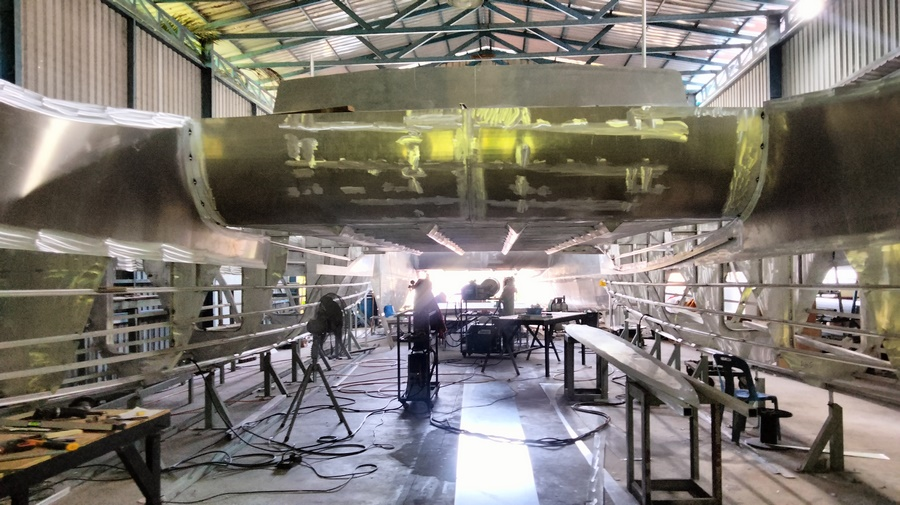
The Mumby 48 is now in production at our Cambodia yard. Frames and structure are fixed — Tim Mumby’s 48-foot performance cruising catamaran, exactly as the design intends — but we’ve also developed a new cabin that delivers significantly more headroom and interior volume, and the first three hulls in our shed all carry it. From that starting point you choose between three interior layouts to match how you’ll actually live aboard. From there, every detail is yours: rig configuration, engines (we recommend Yanmar or Nanni 38hp), deck hardware, fit-out finish, tankage, ground tackle. No two boats that come out of our shed in Kampot are the same. There’s no mould, no factory shift pattern racing to push hulls down a line — just a serious offshore catamaran built in aluminium by people who do this every day, the way you’d want it built if you were paying for it. Which, if you’re reading this, you might be.
This post is the introduction we wish existed when people first start asking us about the Mumby 48 — what it is, why we build it the way we do, and who it’s actually for.
Tim Mumby’s design brief
Tim Mumby is an Australian sailor and designer who’s spent decades drawing high-performance aluminium cruising multihulls. He’s not retired. He still actively designs new work and builds Mumby cats at his own yard in the Philippines — the same hands-on relationship between designer and builder that put the Mumby name on the map in the first place.
The Mumby 48 — also catalogued as the Mumby Cyber 48 or simply the Cyber 48 — is one of his best-known designs. The first hull launched in 2003. By early 2025 there were more than seventy hulls sailing worldwide, with builds done in Australia, the Philippines, and Cambodia. The 2005 Australian-built example still trades regularly on the resale market two decades on, which tells you something about both the durability of the design and the kind of owner who buys one.
That’s a meaningful track record. Most production catamarans on the market today haven’t been around long enough to know how their bridgedecks hold up after twenty years in the trade winds, or how their rigs and ground tackle settle in over a circumnavigation. The Mumby 48 has been answering those questions on the water since 2003, on hulls owned by sailors who actually use their boats.
The design itself sits in Tim’s working tradition: not a show-piece luxury cat with exposed carbon and a beach-club aesthetic, but a working offshore catamaran designed to sail fast, carry load, and survive weather that production cruisers quietly avoid. The hulls are narrow enough to be genuinely fast in any breeze above ten knots, fine enough at the bow to slice rather than slam, and beamy enough overall to give you a real interior. The bridgedeck is high — high enough that you don’t get hammered from below in a beam sea, which is the single thing that destroys sleep on most production cats. The rig is conservative on paper but proportioned to actually drive a fully loaded long-range boat in the trade winds.
What you don’t get with a Mumby 48 is a hull shape compromised to fit eleven cabins, a lounge bar in the saloon, and a flybridge tall enough to need a permit. What you do get is a boat that handles, points, and behaves like a sailboat should.
What we’ve refined at our Cambodia builds
The frames and structure of the Mumby 48 are fixed. We don’t change what’s working, and Tim’s hull design is what’s working. But over our first three hulls we’ve developed and incorporated a new cabin design that significantly improves headroom and interior volume without altering the bridgedeck clearance or the structural envelope. Standing room across more of the saloon, more usable cubic metres for living, more daylight, and the same offshore-capable structure underneath. Every Mumby 48 currently in our shed carries the new cabin.
Owners who’d specifically prefer the original Mumby cabin can still have it — usually that’s owners matching an existing fleet, or owners with a strong preference for the original lines. The new cabin is the recommended choice for most buyers and is what our first three production hulls carry.
For propulsion we recommend the Yanmar or Nanni 38hp diesel, one in each hull. Both are proven cruising-cat engines: reliable, well-supported globally, parts available in any sailing destination you’re likely to head to, and sized appropriately to the displacement of the boat. Owners with specific preferences for other manufacturers — or for parallel-hybrid or full-electric drives — can specify accordingly at the contract stage. The 38hp Yanmar / Nanni pairing is what we’ve validated on our boats and what we’d put in our own.
The three interior layouts
The structural envelope is the same in all three layouts. What changes is how the volume below decks is divided — between cabins, heads, storage, and workshop space — depending on how you intend to use the boat. Every Mumby 48 we build is one of these three plans, refined in detail to your specification.
At a glance:
- Layout 1 — 3 double cabins + 1 single, 2 heads, dedicated laundry and a bigger forward deck storage locker. Owner-cruiser focused, maximum storage, suits long passages and full-time live-aboard.
- Layout 2 — 4 double cabins + 1 single, 2 heads. The standard layout. Most common choice; broadest range of use cases.
- Layout 3 — 4 double cabins, 3 heads. Maximum bathroom-to-cabin ratio. Suits charter use or guest-heavy cruising.
Layout 1 — three cabins with bigger forward storage
The owner-cruiser’s layout. Three double cabins (two aft, one forward in the starboard hull, with dressing table and en-suite shower-toilet) plus a single berth at the workbench station, two shower-and-toilet heads, a dedicated laundry and washing-machine area, and a notably larger forward deck locker. Storage capacity is the biggest gain over the four-cabin layouts — meaningful when you’re provisioning for ocean passages or living aboard full time. Instead of becoming a cabin, the forward port hull becomes proper bridge-deck storage and laundry. If your cruising plans involve fewer guests but longer passages and more self-sufficiency, this is the layout.
Layout 2 — the standard four-cabin layout
The most common choice. Four double cabins (two aft, two forward, one in each hull) plus one single at the workbench station, two shower-and-toilet heads (one in each forward hull), and a smaller deck locker between the forward cabins. This is the layout that suits the broadest range of buyers: cruising couples who host extended family, mixed-generation crews, owners who’ll occasionally move between solo passages and full-family weekends. Strong all-rounder, and the layout we’d recommend if you don’t have specific reasons to choose otherwise.
Layout 3 — four cabins with an extra head
Same four double cabins as Layout 2, but the single workbench berth makes way for a third shower-and-toilet head. Three heads across four sleeping cabins is a much better ratio for guest-heavy use — enough that the boat works seriously well as a charter platform, or for crews where private bathroom access matters. The trade-off is you give up the workshop / single-berth space; if you don’t need that space, you gain a head you’ll be glad to have.
Why aluminium
The choice of aluminium isn’t aesthetic, and it isn’t nostalgic. It’s structural and economic.
Aluminium plate is roughly a third the weight of an equivalent steel structure and significantly lighter than a glass-and-foam fibreglass build of the same dimensions. On a 48-foot catamaran, where displacement directly governs speed, that weight saving translates straight into performance. Lighter boat, faster passages, less fuel for the same range under power, easier handling at anchor.
It’s also the most impact-resistant boatbuilding material in common use. Aluminium dents before it tears. Fibreglass shatters. Nobody plans to hit a container or a half-submerged log on passage, but the boats that survive when it happens are usually metal.
There’s a maintenance argument too — no gelcoat to polish, no osmosis to chase, no chainplates rotting inside fibreglass tabbing — though it’s not a free ride. Aluminium needs proper anti-corrosion treatment, isolated electrical systems, and good paint or anodising in saltwater. Done properly, it’s the longest-lived hull material there is. Done badly, it pits and weeps.
The third reason — the one that doesn’t get mentioned enough — is that aluminium is the only material that makes economic sense for a one-off custom build at 48 feet. A fibreglass mould for a boat this size costs as much as the first boat off it. Aluminium needs no mould. You loft, cut, weld, and you have a hull. It’s why every serious one-off offshore boat above 40 feet for the last fifty years has been built in metal.
Why Cambodia
We get asked this constantly, usually in a tone that implies the questioner expects a defensive answer. There isn’t one.
Cambodia has skilled fabricators. We’ve built our crew over years — coded welders, fitters who’ve been in aluminium since they started working, project managers who understand why a 1.5mm gap matters in a structural weld. The labour is honest, the work ethic is good, and the cost is roughly half what the same crew would cost in a Western country. That cost difference is what makes the Mumby 48 buildable as a custom boat at the price we can offer it. Not because the work is cheaper — because the salary structure here is different.
The facility is a 700 m² dedicated boatbuilding shed in Kampot, on the south coast. Everything is under cover, the building jigs are permanent and aligned to the design’s tolerances, and there’s room for three vessels in build simultaneously. Aluminium plate arrives from Singapore — BV or DNV certified, full traceability — and gets cut into the design’s bulkheads and frames using CAD before it ships. By the time the parts hit the workshop floor, the precision work is already done.
What happens in Kampot is the assembly: fitting, welding, fairing, all the work that no CAD program can do for you. And it’s done by people who’ve done it before, on this exact design.
CAD precision plus traditional lofting
A modern aluminium boatbuild is a mix of two skills that don’t always coexist comfortably. Most of the structure — frames, bulkheads, the major plate panels — is precut by a CNC machine in Singapore from the architect’s CAD files. That gives you accuracy to a fraction of a millimetre on the parts that define the hull’s shape, and it eliminates whole categories of human error.
But CAD doesn’t build a boat. The stem, the keel weldments, the curved topside plates, the small structural pieces that connect everything — those still get lofted manually. Lofting is the traditional craft of drawing a part out at full size, on plywood or directly onto plate, and cutting it to fit the actual physical hull in front of you. It’s centuries old, it requires real skill, and it’s the only way to get a perfect fit where the design tolerances meet reality.
Watch our process and you’ll see both: the precision of automated cutting on the bulkheads and the careful manual lofting on the curved sections. The combination is what gives a custom build its quality. Pure CAD with no lofting tends to produce boats that look right on screen and don’t quite line up in steel. Pure lofting with no CAD takes twice as long and depends entirely on one craftsman’s eye. Doing both gets you precision and fit.
Specifications
The hard numbers, taken from Tim Mumby’s design data sheet for the Cyber 48.
Dimensions
- LOA: 14.55 m (47’9″) — 16.0 m (52’6″) with bowsprit
- LWL: 14.30 m
- Beam overall: 7.53 m (24’8″)
- Beam at hull waterline: 1.176 m (a 7.7% LWL ratio — what makes her fast)
- Hull draught: 0.55 m
- Draught, kick-up rudders down: 0.72 m
- Draught, daggerboards down: 1.80 m
Displacement
- Light: 6,100 kg
- Designed cruising: 7,400 kg
- Maximum (still in performance range): 8,700 kg
- Moment to change trim (MCT): 180 kg per cm
Hydrodynamics and power
- Hull wetted surface (incl. rudders): 38.4 m²
- LCB: 7.732 m aft from bow
- Total drag at 9 kts: 279 kg
- Effective power required: 2 × 29 hp (we recommend 38 hp Yanmar / Nanni for working margin)
Tankage and range
- Water: 2 × 250 L+ (500 L+ total)
- Fuel: 185 L + 470 L (655 L total)
- Range under power: ~1,960 nm at 6 kts on one engine, or ~1,000 nm at 8 kts on two engines
Rig and sails
- Mast: 18.50 m (21 m off water)
- Boom: 6.20 m
- Mainsail: ~79 m²
- Furling headsail: ~48 m²
- Spinnaker: ~145 m²
- Staysail / storm jib: 10 m² / 6 m²
- Winches: Primary 2 × 52 ST 2-speed; main sheet & furling line 2 × 52 ST 2-speed; mast halyards & reefing lines 3 × 42 2-speed
Construction
- Hulls: 4 mm 5083 marine-grade aluminium
- Cabin top and decks: 3 mm 5083 marine-grade aluminium
Download the full Mumby 48 info package (PDF) →
What the spec sheet doesn’t tell you
Those are the numbers. They tell you the Mumby 48 is light for her size, narrow at the waterline, properly tanked for offshore range, and built in genuinely seagoing aluminium. What they don’t tell you is that she’s quiet under sail because the bridgedeck clearance keeps wave slap to a minimum. That she’ll point above 45 degrees apparent in flat water with the daggerboards down, which most cruising cats can’t do. That her motion at anchor is comfortable because the buoyancy distribution is right, not because she’s been over-built and over-weighted to feel “stable.” That her interior is one of three proven layouts chosen at the contract stage to match how you actually intend to live aboard — and then refined in detail rather than reinvented from scratch. That her tankage, electrical capacity, ground tackle, and rig spec are all decided based on how you actually use the boat, not on what fits in a brochure.
This is what production-with-customisation means. It’s not “you can choose your saloon upholstery” — it’s that the structural design is proven and consistent, and the way you’ll live aboard her is yours to specify.
Who the Mumby 48 is for
She’s not for everyone. If you want a charter-spec lifestyle catamaran with a built-in cocktail bar and a flybridge, there are better options at higher prices. If you want a budget production cruiser, there are also better options at lower prices.
The Mumby 48 makes sense for a specific buyer: someone who’s done enough offshore miles to know what they actually want, who values build quality over showroom finish, who’s planning long passages or full-time live-aboard rather than weekend Caribbean charter, and who’s prepared to invest 18 to 24 months and meaningful money in a custom build that will last decades. Couples planning a circumnavigation. Families taking a multi-year sabbatical. Cruisers stepping up from a long-loved monohull. Retirees who’ve waited their whole life for the right boat and want to get it right.
The conversations we have with prospective owners tend to be long. We expect that. A custom boat isn’t a transaction; it’s a partnership that lasts the better part of two years before you ever sail her, and decades after.
From contract to sail-away
The build itself runs in three broad phases. The first six to nine months are structural — jig setup, hulls, bulkheads, beams, deck. The middle phase is fit-out — interior joinery, systems, plumbing, electrical, the work that turns a hull into a boat. The final months are commissioning — rig stepping, sea trials in the Gulf of Thailand, snag list, paperwork, flag registration.
Owners visit when they want to. Many fly in for major milestones — first weld on the keel, hulls coming off the jig, mast stepping, sea trials. We host them at the workshop, walk them through whatever’s currently in build, and answer questions until they run out.
When the boat’s done, you don’t ship her. The Mumby 48 leaves Cambodia on her own bottom — that’s the whole point of an offshore-capable catamaran. Most owners take delivery in Kampot, sail down through the Gulf, and head wherever home is. We can arrange a delivery skipper if you’d rather your first long passage be your second long passage. The boat’s first crossing is itself the final test of the build.
Talking to us
If any of this resonates — the philosophy, the materials choice, the build approach, the boat itself — the next step is a conversation. Not a sales pitch; a conversation. We want to understand how you’ll use the boat, what you’ve sailed before, what you actually want versus what you think you should want. From there we can put together a realistic proposal: spec, timeline, price, build slot.
Get in touch with the Coastal Boats team →
You can also follow the build progress for current vessels at mumby48build.com, or read our aluminium vs fibreglass comparison if you’re still working through the materials question.
Coastal Boats (Cambodia) Co Ltd builds custom aluminium performance catamarans in Kampot, Cambodia. BV / DNV certified plate, coded welders, 700 m² dedicated facility.
